

The position of your jaw determines how your head rests on your spine. Even slight imbalances can change muscle tone in the neck, shoulders, and back, creating a chain reaction that alters posture and movement.
Symptom
When Your Bite Affects Your Body
The alignment of your jaw influences your head, neck, and spine. At the TMJ & Sleep Therapy Centre of Raleigh-Durham, we treat orthopedic dysfunction by addressing the source — your jaw and airway balance.

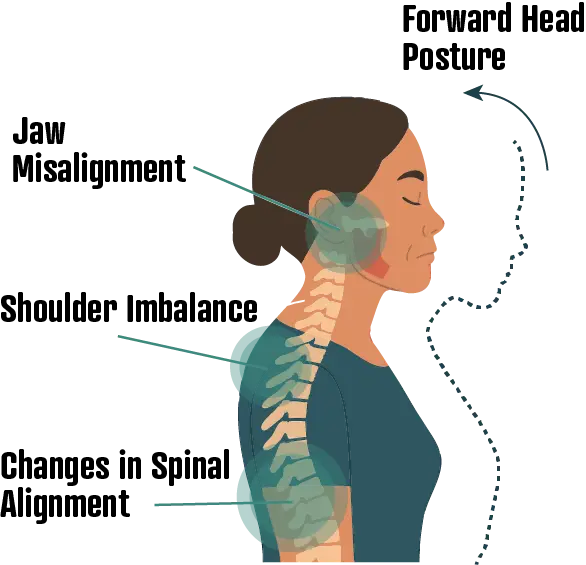
Understanding Orthopedic Dysfunction from TMJ Misalignment
Orthopedic dysfunction refers to imbalance or misalignment in the muscles and joints that support your posture and movement. While many people associate these issues with the spine or hips, few realize how often they begin in the jaw. The temporomandibular joint (TMJ) plays a vital role in head posture and muscle tone throughout the neck and shoulders. When the jaw is misaligned, it can shift the head’s resting position, forcing the rest of the body to compensate.
At the TMJ & Sleep Therapy Centre of Raleigh-Durham, we evaluate the body as an integrated system. TMJ imbalance can contribute to forward head posture, uneven shoulders, pelvic rotation, and chronic back pain. By correcting jaw position and muscle balance, we help patients restore proper biomechanics, reduce pain, and prevent long-term joint wear.
When To Seek Treatment
Chronic Neck and Shoulder Strain
Persistent tightness in the upper back or shoulders may stem from jaw misalignment that disrupts head posture and balance.
Postural Imbalance or Tilt
When the TMJ or bite is uneven, the head tilts or rotates subtly, creating full-body compensation patterns over time.
Back Pain or Hip Misalignment
Spinal tension and pelvic rotation may arise as your body tries to stabilize a forward-shifted head or uneven jaw position.
Uneven Gait or Shoulder Height
Imbalances from the jaw joint can cascade through the body, subtly altering your walking pattern or shoulder symmetry.
Relief begins with the right diagnosis
If you’re living with chronic pain, tension, or postural imbalance, your jaw could be the missing piece. At the TMJ & Sleep Therapy Centre of Raleigh-Durham, we bring the jaw, airway, and body back into harmony for long-term orthopedic stability.
Frequently Asked Questions About Orthopedic Dysfunction
TMJ disorders don’t just affect the jaw — they can influence the entire musculoskeletal system. Here are some common questions about the connection between TMJ dysfunction and orthopedic pain.
Yes. When the TMJ is properly aligned, it helps restore equilibrium across the head and neck. Patients often notice that their shoulders level out and their neck feels looser after beginning treatment.
The body is an interconnected system. A forward or rotated jaw changes your head’s center of gravity, forcing the spine and hips to compensate. Over time, these adaptations lead to lower back pain and muscular imbalance.
In most cases, yes. With proper therapy and postural re-education, the body can realign once muscle strain and jaw position are corrected. Early intervention improves outcomes and helps prevent chronic changes.
Our care plans combine diagnostic imaging, custom orthotic therapy, muscle balance rehabilitation, and postural correction. These therapies restore harmony between your jaw, head, and spine for lasting relief.